Marco Manzo’s Manifesto of Contemporary Artistic Tattooing Presented at MoMA in New York

The Manifesto of Contemporary Artistic Tattooing arrives at MoMA
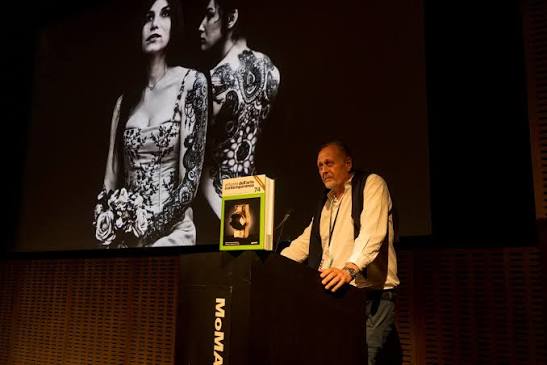
Italian artist Marco Manzo’s Manifesto of Contemporary Artistic Tattooing was presented at the Museum of Modern Art (MoMA) in New York, marking another milestone in the recognition of tattooing as an authentic language of contemporary art.
The presentation took place on June 19 during the launch of the Atlas of Contemporary Art, the prestigious publication by Giunti that has become an essential reference for scholars, curators, collectors, and art professionals.
Marco Manzo presents the Manifesto of Contemporary Artistic Tattooing
The event featured a special focus on the artistic research of Marco Manzo, an internationally acclaimed visual artist, tattoo artist, sculptor, and designer.
For years, Manzo has been committed to promoting tattooing as an artistic medium capable of engaging with the languages of contemporary art, contributing to the cultural debate surrounding its institutional recognition.
The presentation of the Manifesto of Contemporary Artistic Tattooing represents a significant milestone in this journey. Rather than recounting only the artist’s personal experience, the document offers a broader reflection on the future of artistic tattooing, its cultural value, and its place within the international contemporary art landscape.
Giunti publishes the first excerpt of the Manifesto
On the occasion of the New York presentation, Giunti Editore released the first excerpt of the Manifesto, offering an early look at its contents. The complete text was officially unveiled during the event, where Marco Manzo illustrated the principles, objectives, and vision behind the document before an audience of scholars, critics, curators, and art professionals.
The initiative received the official patronage of the Italian Cultural Institute of New York, which granted its institutional endorsement and official logo to the Manifesto, recognizing its cultural significance and international relevance.
At the conclusion of the event, the Manifesto was officially signed in New York, marking the beginning of a project intended to engage artists, institutions, museums, and scholars.
A codified method for the recognition of artistic tattooing
According to Marco Manzo, the Manifesto introduces a codified method designed to fill a long-standing gap within the contemporary art system.
The artist argues that the cultural debate surrounding the legitimacy of tattooing as an artistic expression can now be considered substantially complete. Italy has played a leading role in this process, beginning with contemporary art museums and their collections, continuing through major international exhibitions such as the Venice Biennale of Art and Architecture, and extending even to important ecclesiastical institutions.
This process of institutional recognition has also been celebrated in the United States thanks to the attention devoted by major cultural institutions, including the Metropolitan Museum of Art in New York, the Museum of Modern Art (MoMA), and Art Basel Miami Beach, widely regarded as the world’s leading contemporary art fair.
According to Manzo, Italy and the United States have become the two countries that define this historic turning point in the institutional recognition of artistic tattooing.
The final step toward institutional recognition
In Marco Manzo’s vision, the Manifesto represents the final step necessary to position tattooing alongside every other artistic discipline, granting it the same standards of conservation, legal protection, collecting, and historical recognition.
The objective is not to alter the intrinsic nature of tattooing but to apply a model already adopted by the contemporary art world for performance art. Just as performances are documented, certified, archived, and collected through their official documentation, artistic tattoos can now follow the same institutional process.
From this perspective, tattooing becomes a documentable, certifiable, collectible, and historically preservable artwork while maintaining its original identity as a living artistic expression.
The first catalogue raisonné and legal archive for artistic tattooing
One of the Manifesto’s most innovative contributions is the creation of the first catalogue raisonné accompanied by a legal archive, designed to protect both artists and collectors.
This system establishes an official method for documenting and certifying tattoo artworks, providing museums, collectors, curators, and scholars with recognized standards for preservation, authentication, and cataloguing.
Today, many tattoo artists document their work by publishing photographs on websites or social media platforms. The method proposed by the Manifesto introduces an additional archival and legal framework, creating new opportunities for artists pursuing a genuine contemporary artistic practice.
Marco Manzo: “I have opened a path that others can now follow”
Marco Manzo explains that his artistic journey has achieved results that would have seemed unimaginable only a few years ago.
His objective, however, is not simply to promote greater acceptance of tattooed people. Rather, he believes that the achievements embodied in the Manifesto should become a shared cultural heritage for the entire artistic community.
According to Manzo, the Manifesto is intended as a collective accomplishment that offers a structured methodology for every artist wishing to develop tattooing as a fully recognized language of contemporary art.
He concludes by stating that he has opened a path which, thanks to this new method, can now be followed by others, contributing to the official and institutional inclusion of tattooing within the contemporary art system.